
Learning Technologies
Overview
The use of technology to support, extend and enhance learning is central to the curriculum at Willow Dene. We use a wide range of carefully chosen technologies to meet children’s individual needs. Each class team works collaboratively to drive the effective use of technology across the whole school, ensuring that provision is well-matched to children and young people's needs and that staff competencies are continually developed and updated.
Click the tabs below to find out more about some of the ways we use technology at Willow Dene.
Access
At Willow Dene, one our core aims is to support our children and young people's ability to access and control technology. We develop these skills using one or more of the access methods below, aiming for the children to access technology with the minimum of effort, so that their concentration can be focused on the intended learning. Children and young people may be working on developing more than one skill in different contexts.
We have many specialist and cutting-edge access technologies, including Eye-Gaze touch screens, medical-grade pneumatic monitor arms, and switches, as well as specialist keyboards and pointers, such as track pads, joysticks and tracker balls.
Touch screen skills may be practised with the iPads, but we may be following a separate range of access targets, specific to children and young people's needs and the different control methods on these devices. Children and young people's access targets may be focused on swiping, finger isolation or gestures.
Computers
All classrooms have at least one PC/laptop and either an interactive whiteboard or plasma screen. Children use computers to support literacy and numeracy, as well as other areas of the curriculum. Children also work on personalised access targets, developing their ability to functionally use the computer with a switch, touchscreen, joystick, tracker ball, mouse or keyboard. Our core software that supports children’s learning includes:
- Many titles from the Inclusive Technology Switch Skills range.
- Clicker 8 – software that can be customised to support the curriculum and personalised to meet children and young people's learning and access needs. It is particularly good for supporting children and young people's literacy.
- Lots of fantastic titles from the Q&D Multimedia range. These can be accessed from home for free under the Busy Things umbrella. Please see the separate link for details.
- Online resources from a range of sources.
COSMO
We also use specialist technology at Willow Dene, such as COSMO, to support multi-sensory access, and to develop social, communicative and play skills. COSMO also helps our children and young people develop their numeracy, literacy and cognitive skills through various games that challenge and motivate.
iPads
The Apple iPad is one of the most popular learning interfaces in our school. It's easy to use touch screen, rugged construction and our cherry-picked selection of apps make it the perfect tool for many of our children and young people to access technology. Each class has access to two iPads, and we also have multiple banks of iPads across both sites that can be booked for use during the school day. These devices are available with a variety of protective cases to meet a wide range of needs.
The IT Team have selected a set of apps for use with the children and young people. These range from popular books to interactive puzzles, fun image-editing apps to communication aids. The set also include problem solving, creative apps, and apps on topics such as Numeracy and Literacy. We have many sensory apps which support children and young people's understanding of basic cause and effect, as well as providing relaxing and soothing content. There are also lots of great apps which support creativity in music, sound and art.
Alongside the core app collection, teachers carefully research and select specific apps, which will support learning in the half termly topic or a targeted area of learning for individual children and young people. These are continually updated.
Sonos
One of Willow Dene’s most successful investments in ICT infrastructure has been the Sonos sound system. Sonos is a "smart" system of wireless speakers and audio components, which uses wifi. It allows a digital music collection to be easily controlled from many devices, including iPads, class PCs and tablets.
Each class, across both sites, has a Play 3 speaker which is linked to their class iPad. Having converted all of our CDs to MP3 files, and supplemented this with a targeted order of music, songs and audio books, we have a huge centrally-stored audio library that is easy to access and search by artist, track, album, genre – just as you would expect of a digital library. This is updated half-termly as teachers select new audio resources to support children’s learning.
Sonos is also in our shared areas and specialist learning environments, meaning that we have access to the same wide range of high-quality audio resources everywhere within school. Within the halls and swimming pool, we have purchased tablets to control Sonos so that music and songs are always readily accessible – no more shuffling around through a pile of scratched CDs!
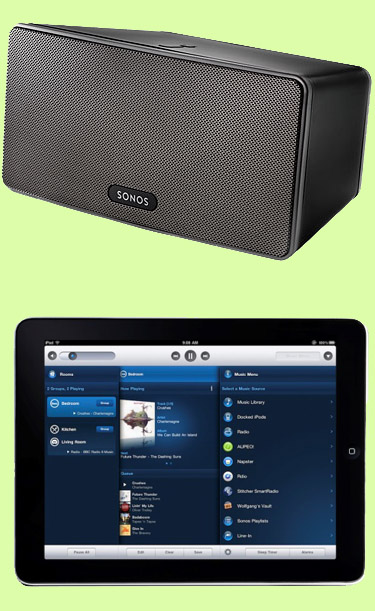
There has been a marked increase in the use of auditory resources to support learning across the school, including:
- Auditory cues to support children in transitions are used more consistently and creatively to cue them into something about to happen like tidying up, dinner or home time.
- The use of music to enhance the environment at key times, such as breaks and self-care sessions.
- The consistent use of the music aspect of the sensory calendar, which has a different genre of music for each day and complements other sensory markers including tactile and olfactory.
- The use of music to support sensory processing sessions, where children are encouraged to develop a greater awareness of their bodies and how they feel.
- The use of audio-books, enabling children to access stories independently.
- The use of music to complement learning opportunities, such as Write Dance or art.
- The consistent use of music resources, for example in assemblies and PE sessions.
- The creative use of music and sound effects to support our themed swimming lessons in the school pool.
- The use of familiar and appropriate songs to promote MOVE skills in MOVE groups, the MOVE gym and Aqua MOVE .
Eye-Gaze
Willow Dene recognises the significant potential offered by eye-gaze technology to support children and young people's learning and communication, particularly for children and young people with physical disabilities, who are working at early development levels.
Through using eye gaze to access a computer, children and young people work through a progression of awareness, control and skills, which starts with sensory awareness, then progresses onto early eye-tracking, exploration and choosing, then on to more advanced skills of turn-taking and communication.
At every stage, the aim is for learning to be fun and personalised for children and young people's individual motivations and ability. Eye Control and Gaze Interaction are taught in a structured way, in order to support children and young people to learn the practical and cognitive skills needed to reach the level of ability required to actively make choices. Ultimately, eye gaze technology enables children and young people who have very limited physical movement to exert control over their environment.
We are committed to evolving and enhancing the learning landscape for all children and young people. Eye-gaze technology has the potential to provide some of our children and young people a unique way of independently exploring and engaging, and have fun doing it.
Since we introduced our first system in 2013, eye-gaze has had a significant impact on our children and young people's learning, not only cognitively and communicatively, but also supporting physical skills of head control. As well as a dedicated eye-gaze studio on each site, which enables children and young people to use the technology in a distraction-free environment, we have introduced eye-gaze systems into nine of our classroom settings, where there are a high number of users who benefit from more frequent opportunities to practice their skills.
We are constantly expanding our repertoire of eye-gaze software. Our favourite titles include:
AAC
AAC stands for Augmentative and Alternative Communication. This is the term used to describe methods of communication that can support people to communicate. It may include unaided systems such as giving consistent responses or signing, or aided techniques that use objects or symbols to represent things (such as PECS), right through to sophisticated computer technologies.
We work closely with speech and language therapists (SaLT) and occupational therapists to ensure we are enabling children to communicate effectively, through the most appropriate powered and non-powered systems. These systems are highly personalised and reflect children and young people's communicative strengths and needs, aiming to develop and expand their communication skills.
When we use technology-based systems, we always aim for children and young people to have a non-powered system that runs alongside it. Developing children and young people's skills with non-powered systems is often the most appropriate starting point, before looking at powered-based solutions. Class teams meet regularly with a member of the SaLT team to discuss the communication priorities for children and young people in their class. We have a Communication Referral System that is accessed internally through SharePoint, where staff can identify children and young people who are in need of specialist AAC provision.
We also run termly AAC Clinics to assess and explore identified children and young people's AAC needs. The purpose of Willow Dene’s AAC Clinic is to support children and young people with a short-term trial of an iPad communication app where their communication profile suggests they may benefit from exploring a powered-based AAC system.
We provide enhanced support to help children and young people develop and evidence the skills needed to apply to a long-term loan for the child or young person's communication device. The referral for a long-term loan will be completed by a Speech and Language Therapist (SaLT) and this will be to either, GOSH (Great Ormond Street Hospital) or CENMAC (AAC Hub) as decided by the managing therapist.